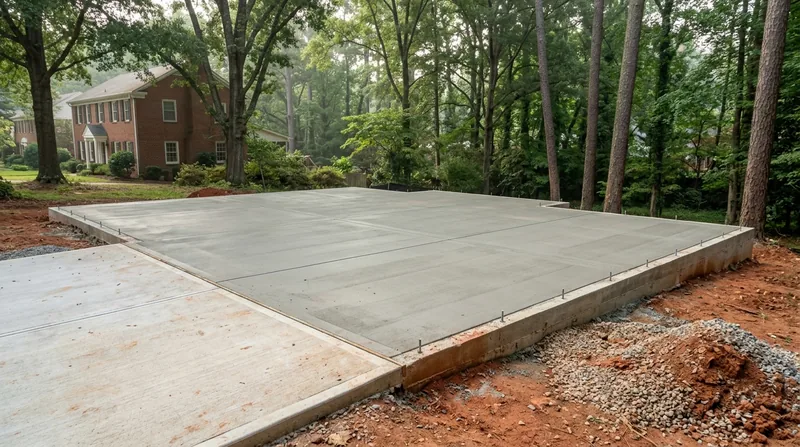




Concrete Slabs & Foundations in Charlotte are the backbone of every structure, from garage additions to new construction footings. Charlotte's Piedmont terrain, with its rolling hills and fast-draining red clay over soft weathered saprolite, demands slabs and foundations engineered for stability and longevity. Freeze-thaw cycles, seasonal clay shrinkage and swelling, and the weight of brick Colonial Revivals and modern two-stories all put stress on improperly designed concrete. A solid foundation isn't just poured concrete, it's compacted base preparation, proper reinforcement, and thickness calculated for your soil and load. We build slabs and foundations that hold up through Charlotte's winters, humid summers, and the occasional tropical storm remnant.
Why Concrete Slabs & Foundations Matter in Charlotte's Piedmont Soils
Charlotte sits on Iredell-type clays and red clay over saprolite. These soils shrink and swell with seasonal moisture changes, heaving walks, cracking slabs, and lifting foundations if the base preparation and reinforcement aren't done right. A slab poured directly on undisturbed clay without proper compaction and a gravel base will fail within 5 to 10 years. Winter freeze-thaw cycles, salt tracked from treated roads, and summer downpours all accelerate deterioration. Your foundation or slab must be engineered for this climate and soil type.
- We compact and grade the subgrade to remove soft spots and ensure uniform bearing capacity before any concrete goes down.
- We install 4 to 6 inches of compacted gravel base to promote drainage and prevent water from pooling under the slab.
- We specify steel reinforcement (rebar or wire mesh) sized for the slab thickness, load, and soil conditions in your zone.
- We pour concrete at the right thickness (typically 4 to 6 inches for residential slabs, 8 to 12 inches for garage floors and footings) to handle weight and freeze-thaw stress.
- We slope the slab slightly for drainage and finish the surface to code and your intended use.
Proper foundation and slab work prevents settling, cracking, and the need for expensive repair or replacement later.
Key info: In Charlotte neighborhoods like Dilworth, Elizabeth, and Myers Park, older homes built on shallow footings or unreinforced concrete often show foundation cracks and heaving after 50+ years of freeze-thaw and clay movement. New slabs and footings for room additions or garages must meet current standards to avoid the same fate. Check with the City of Charlotte Building Services for foundation setback and depth requirements before you dig.
How We Build Concrete Slabs & Foundations: Step by Step
Every slab and foundation starts with site assessment. We inspect the soil, measure drainage patterns, check for tree roots or underground utilities, and confirm local setback and permit requirements. Then we excavate, compact, and prepare the base. We set forms to grade and height, install reinforcement, and pour concrete at the right time of day to avoid rapid set in summer heat or slow cure in cool weather. Finishing and curing are as important as the pour itself.
- We schedule a site visit to evaluate soil conditions, drainage, and any permit or HOA requirements for your project.
- We excavate to the required depth and grade, removing organic material and soft clay down to stable bearing soil.
- We compact the subgrade in 4 to 6 inch lifts using a vibratory plate or roller to achieve 95% standard proctor density.
- We lay down 4 to 6 inches of compacted gravel base and install a vapor barrier if required for interior slabs or basements.
- We set and brace forms, install rebar or wire mesh per structural design, and check elevations and slopes before the pour.
- We cure the slab by keeping it moist for 7 days (using plastic sheeting or spray curing) to develop full strength and minimize cracking.
This methodical approach ensures your slab or foundation will support its load and resist Charlotte's climate for decades.
Local example: A homeowner in Ballantyne adding a 400-square-foot mudroom to a 1990s brick two-story needed a new foundation and slab. We excavated 24 inches into red clay, compacted the subgrade, installed a 4-inch gravel base, set forms to the correct slope, poured 5 inches of reinforced concrete, and cured it for a full week. The slab has been solid for three years, with no settlement or cracks. See our work on concrete patios and concrete repair and resurfacing for more Charlotte examples.
Concrete Slab and Foundation Methods
| Approach | Description | Best for |
|---|---|---|
| Standard Poured Concrete Slab | 4 to 6 inch reinforced slab on compacted gravel base with proper slope and finish. | Garages, storage sheds, patios, room additions, and general-purpose foundations in residential Charlotte. |
| Thickened Edge Slab | Slab with a deeper perimeter edge (8 to 12 inches) to handle frost depth and load concentration along the foundation line. | Additions and new construction where frost depth and local code require deeper edge support in Charlotte's freeze-thaw zone. |
| Garage Floor Slab | 6 to 8 inch reinforced slab with heavy-duty finish, control joints, and slope for drainage; rated for vehicle and equipment weight. | Attached or detached garages, carports, and covered parking areas in Huntersville, Matthews, Mint Hill, and throughout Charlotte. |
| Stepped or Terraced Slab | Multiple slab elevations following sloped terrain, with proper drainage and reinforcement at step transitions. | Hillside homes in Myers Park, Eastover, and Sedgefield where patios and foundations step down the slope to match grade. |
| Post-Tensioned Slab | Reinforced concrete slab with high-strength cables under tension to reduce cracking and increase load capacity on problem soils. | Large additions, commercial slabs, or sites with high clay swell potential where standard reinforcement alone is insufficient. |
Concrete Slabs & Foundations Cost in Charlotte: What to Expect
Concrete slabs and foundations in Charlotte typically start at $5 per square foot for a standard residential slab on a compacted gravel base with basic reinforcement. However, the final price depends on several factors specific to your site and soil. Excavation depth, clay conditions, drainage requirements, required base preparation, concrete grade, reinforcement type, and local permit fees all move the price up from that baseline. A 400-square-foot garage slab might run $2,000 to $2,500 if the site is level and accessible, but a hillside foundation with stepped edges and special drainage could easily reach $3,500 to $4,500 or more. Always get 2 to 3 estimates from insured contractors, and ask each one to explain what's included in their price and what soil or site conditions might change it.
For detailed pricing on various slab and foundation sizes, visit our full pricing overview. Every estimate includes a site visit, soil assessment, and a clear breakdown of labor, materials, and any permit or disposal costs. We respond within 24 hours at (980) 890-4168.
What to Look for When Hiring a Concrete Contractor Near Charlotte
Hiring the right contractor for your slab or foundation is critical. You want someone who understands Charlotte's clay soils, freeze-thaw conditions, local permit requirements, and the importance of proper base preparation. Don't choose based on price alone, get multiple bids, ask for references from recent Charlotte-area jobs, and verify that the contractor carries full general liability and workers' compensation insurance. Ask to see a certificate of insurance for every job. Understand what permits your city or county requires (Charlotte, Concord, Gastonia, Matthews, and other municipalities have different rules for footings, setbacks, and right-of-way work), and make sure your contractor handles permitting or coordinates with the city on your behalf. If your property is in an HOA, check any architectural or construction rules before work begins.
- Request general liability insurance and workers' compensation coverage from any contractor you hire, and ask for proof on every job.
- Ask for at least three references from slab and foundation projects completed in Charlotte or nearby in the last two years.
- Confirm that the contractor understands local setback, depth, and width requirements for your city and property type.
- Get a written estimate that lists excavation, base preparation, concrete volume, reinforcement, finishing, and any permit or disposal fees separately.
- Verify that the contractor will handle or coordinate all required permits with the City of Charlotte or your local municipality.
- Check whether your HOA has restrictions on foundation work, timing, or contractor access before you book.
Taking time to hire carefully protects your investment and ensures the work meets code and lasts for decades.
Ready to discuss your slab or foundation project? Contact us today for a free, no-obligation estimate.
Concrete Slabs & Foundations in Charlotte: Pricing Guide
| Service | Price | Details |
|---|---|---|
| Standard residential slab | Starting at $5/sq ft | 4 to 6 inch reinforced slab on compacted gravel base, finished and cured; base preparation and soil conditions affect final cost |
| Garage floor slab | Starting at $6/sq ft | 6 to 8 inch reinforced slab rated for vehicle weight, proper slope for drainage, control joints, and durable finish for durability |
| Foundation with thickened edge | Starting at $7/sq ft | 8 to 12 inch perimeter edge for frost depth and load concentration in Charlotte's freeze-thaw zone; includes proper reinforcement |
| Stepped or terraced slab | On estimate | Multiple elevations on sloped terrain require site assessment, drainage design, and reinforcement at transitions; hillside work costs more |
| Travel and permit coordination | Included | No separate mileage fee for Charlotte and surrounding service areas; permit research and filing coordination included in estimate |
| Free estimate | No obligation | Site visit, soil assessment, and written quote within 24 hours at (980) 890-4168; no charge to review your project |
Indicative pricing, the exact cost depends on square footage, finish, and site access. Free personalized estimate within 24h at (980) 890-4168.


